News & Events
Stay updated to Dreamztrack's news and annoucements, and follow us to stay ahead on the courses and events that we may have from time to time.


Stay updated to Dreamztrack's news and annoucements, and follow us to stay ahead on the courses and events that we may have from time to time.

The AGI era is often described as a distant science-fiction milestone. For small businesses, the more useful question is closer to home: what should you build now so that increasingly capable AI makes your company faster, more responsive and easier to manage?
Artificial general intelligence (AGI) does not have one agreed definition or a confirmed arrival date. A useful framework from Google DeepMind researchers describes progress through levels of performance, generality and autonomy rather than a single switch being turned on. That uncertainty is not a reason to wait. It is a reason to prepare around practical capabilities that already matter: reliable information, clear workflows, good customer data and sensible human oversight.
Today’s business AI can already answer common questions, summarise conversations, draft messages, classify leads and schedule appointments. More capable systems may eventually handle longer chains of work across sales, service, marketing, finance and operations. Instead of responding to one prompt, an AI agent could watch for a new enquiry, understand its context, check availability, recommend the next action, prepare a reply and ask a team member to approve an unusual case.
That does not mean every business will become fully autonomous. In practice, the advantage will go to companies that combine automation with a strong operating model. AI cannot fix a pricing policy nobody understands, a customer database full of duplicates or a sales process that exists only in one employee’s memory. The AGI era will reward businesses that make their knowledge usable.
A common mistake is to ask, “Where can we add AI?” A better starting point is to map what happens from the first enquiry to the completed sale and the follow-up afterward.
For a service business, that journey might include a WhatsApp message, a question about price, a request for examples, a qualification step, an appointment booking, reminders and a handover to a human consultant. Mark each stage where customers wait, repeat information or receive inconsistent answers. Those are better automation opportunities than adding an AI feature simply because it is fashionable.
Dreamztrack’s AI chatbot, WhatsApp messaging and lead-management workflows fit this practical approach. A business can begin with fast responses and structured lead capture, then connect those conversations to scheduling, follow-up and performance tracking. The goal is not to remove the human relationship. It is to make sure a promising customer is not lost because nobody replied in time.
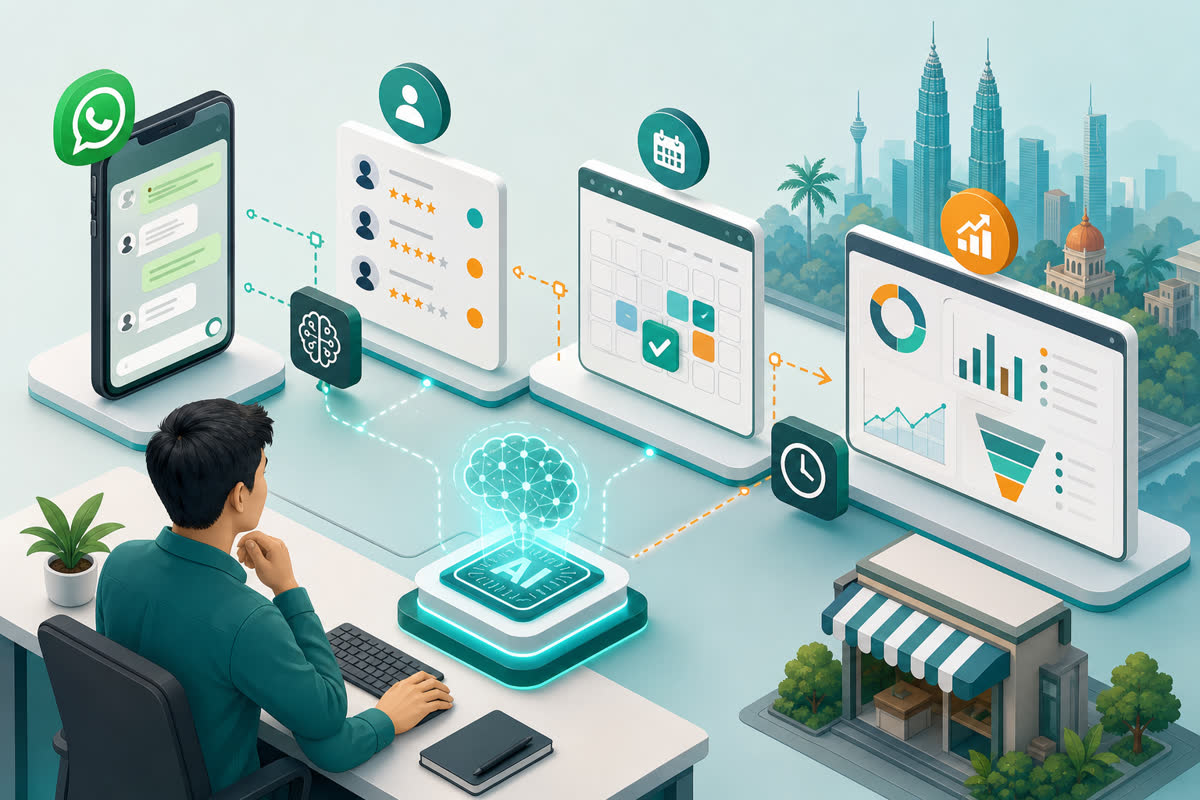
More capable AI needs more than access to the internet. It needs accurate business context. That includes your services, prices, eligibility rules, refund policy, operating hours, service areas and escalation guidelines.
Write these rules in plain language and keep them in one maintained source. Separate facts that AI may use automatically from decisions that require approval. For example, an assistant may explain a published package price, but a staff member may need to approve a special discount. It may collect the details needed for a quotation, but a qualified person should review a complex request.
This work sounds basic, yet it creates a durable advantage. When business knowledge is organised, the same source can support a chatbot, a sales dashboard, staff training and internal reporting. When knowledge is scattered across old messages and personal notebooks, every new automation project becomes slow and risky.
AGI-era tools will only be as useful as the records they can read. Start with a few data habits:
These practices also improve ordinary business decisions. With reliable lead and sales data, an owner can see which campaigns produce conversations, which staff follow up consistently and where prospects stop moving. Dreamztrack’s ads analysis and sales performance tools can help turn those records into a clearer view of what is working.
Automation should have boundaries. An AI assistant can be excellent at triage, summarisation and routine replies while still being unsuitable for decisions involving sensitive personal information, disputed payments, legal commitments or vulnerable customers.
Create an escalation path before deployment. Define the situations that require a human, the person who receives the handover and the maximum time allowed for a response. Keep an audit trail of important actions. Give customers a clear way to reach a person when an automated answer is wrong or incomplete.
The National Institute of Standards and Technology’s AI Risk Management Framework encourages organisations to manage AI risks through practical governance rather than treating safety as a one-time certification. For a small business, that can be as simple as documenting the system’s purpose, testing common failure cases, checking access permissions and reviewing outcomes every month.

The AGI era will change tasks before it changes job titles. Staff may spend less time copying information between systems and more time checking recommendations, handling exceptions, building relationships and improving the customer experience.
Training should therefore be tied to real workflows. Show a salesperson how to review an AI-generated lead summary. Show a support employee how to correct a knowledge-base answer. Show a manager how to read conversion data and spot a process problem. Encourage staff to report failure cases rather than quietly working around them.
The strongest teams will not be those that accept every AI output. They will be the ones that know when to trust it, when to verify it and how to improve the system after it makes a mistake.

Do not begin with a promise to “transform the whole company.” Pick one workflow with a clear baseline and a clear owner. Examples include responding to new WhatsApp enquiries, confirming appointments, reminding prospects who requested a quotation or summarising daily sales activity.
Measure response time, qualified leads, appointment completion, conversion rate, human handovers and customer complaints. Run the experiment long enough to see normal variation. If the result is positive, document the process and expand carefully. If it fails, learn whether the problem was the model, the instructions, the data or the underlying workflow.
A 15-minute chatbot setup can be a useful starting point, but speed should not replace measurement. The real test is whether customers receive better service and whether the team can handle more valuable work without losing control.
Every SME can take four practical steps now:
Then review the result with the people who use the process every day. Their feedback will reveal problems that a dashboard may miss, such as confusing questions, awkward handovers or customers who prefer a human reply.
The AGI era will not be won by the business that makes the boldest prediction about the future. It will be won by the business that learns faster, responds consistently and keeps improving its systems without abandoning human judgement.
AGI may arrive gradually, through a series of increasingly capable assistants and agents rather than one dramatic event. That makes preparation accessible. Start with the conversations customers already have, the decisions your team already makes and the information your business already owns. Connect those pieces carefully, measure the outcome and expand only when the workflow is ready.
For Malaysian SMEs, the opportunity is practical: combine AI chatbot support, WhatsApp engagement, lead management and ads analysis to build a business that is more responsive today and better prepared for whatever the next generation of AI brings.

AI Developement Company in Johor Bahru
64-01 & 64-02, Jalan Molek 2/2,
Taman Molek, 81100,
Johor Bahru, Johor, Malaysia.

